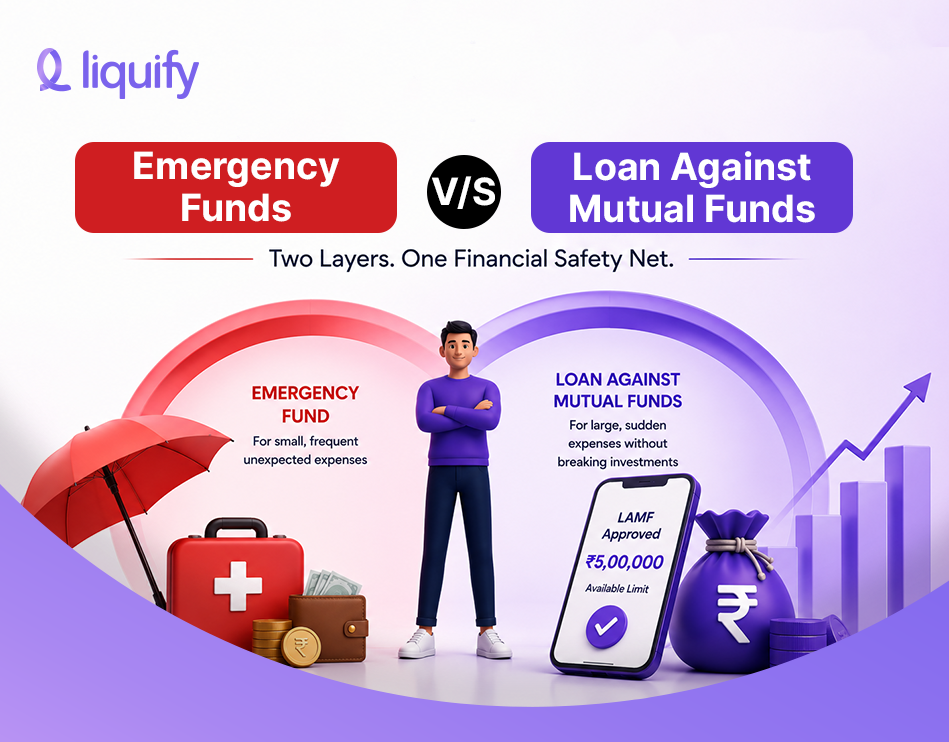
Emergency Fund vs Loan Against Mutual Funds
Most financial advice treats emergency fund vs mutual fund loan as separate topics. They aren’t. They solve different parts of the same problem: how do you handle unexpected expenses without breaking your long-term investments?
An emergency fund covers small, frequent surprises. A car repair. An appliance replacement. A sudden medical test. These are ₹10,000–₹50,000 expenses that show up a few times a year.
LAMF covers large, sudden expenses that your emergency fund can’t absorb. For example, a hospitalization costing ₹3–5 lakh, a family wedding, or a semester fee with a 10-day deadline. These are ₹1–10 lakh situations where your emergency fund vs LAMF decision actually matters.
The mistake most investors make is relying on only one of these. An emergency fund alone runs out during large expenses. LAMF alone is unnecessary for a ₹15,000 car repair. The right approach uses both as layers.
Emergency fund vs Mutual fund loan-Key Takeaways
- The emergency fund covers expenses up to ₹50,000–₹1 lakh. LAMF handles ₹1 lakh and above.
- 75% of Indian households don’t have an emergency fund at all
- An emergency fund should ideally cover 3–6 months of essential household expenses
- LAMF gives you access to ₹50,000–₹10 lakh+ within 24 hours without selling investments
- Together, these two tools mean your equity portfolio never needs to be redeemed
What Is an Emergency Fund Designed For?
An emergency fund is liquid cash set aside for unplanned, short-term expenses. Financial planners recommend keeping 3–6 months of essential expenses in a liquid mutual fund or high-yield savings account.
For a household spending ₹50,000 per month on rent, groceries, utilities, insurance, and school fees, that’s ₹1.5–3 lakh parked in a highly liquid instrument earning 6–7% annually.
What it handles well:
- Appliance breakdowns (₹5,000–₹30,000)
- Minor medical expenses (₹10,000–₹50,000)
- Car or bike repairs (₹5,000–₹25,000)
- Temporary income gaps of 1–2 months
Where it falls short:
- A hospitalization costing ₹3–5 lakh wipes out the entire fund
- A wedding or education fee of ₹5–10 lakh is well beyond its capacity
- A job loss lasting 4–6 months drains it completely, leaving nothing for other emergencies
The emergency fund is your first line of defence. It handles frequency. It doesn’t handle magnitude.
What Is LAMF Designed For?
A loan against mutual funds is a secured overdraft facility. You pledge your mutual fund units, get a line of credit of up to 50% of NAV for equity and up to 85% for debt funds, and withdraw what you need. Interest is charged only on the withdrawn amount at 9–13% p.a*.
What it handles well:
- Large medical emergencies (₹1–10 lakh)
- Wedding or education expenses arriving in phases
- Job loss, cash flow gaps lasting 3–6 months
- Business working capital needs
Where it’s unnecessary:
- Small expenses under ₹50,000 that your emergency fund can cover
- Expenses you can pay from next month’s salary
- Situations where you don’t hold mutual funds
LAMF is your second layer. It handles magnitude. Using it for a ₹15,000 expense adds processing fees and unnecessary complexity.
How Do These Two Layers Work Together?
Here’s a practical scenario. Rohan earns ₹80,000 per month. His essential expenses are ₹55,000 monthly. He has a ₹2 lakh emergency fund in a liquid fund and a ₹12 lakh equity mutual fund portfolio.
Scenario 1: His washing machine breaks down. Repair cost: ₹12,000.
He uses the emergency fund. No loan needed. Replenishes the fund over the next 2 months from salary savings.
Scenario 2: His father is hospitalized. Bill after insurance: ₹4.5 lakh.
His emergency fund covers ₹2 lakh. The remaining ₹2.5 lakh comes from LAMF against his equity portfolio at 9.3% p.a.*. He repays the LAMF over 4 months as salary comes in. Total interest: ~₹3,875. His portfolio stays invested. His SIPs continue.
Without LAMF, Scenario 2 forces Rohan to redeem ₹2.5 lakh from his equity portfolio.
That triggers LTCG tax at 12.5% on proportional gains, permanently removes those units from compounding, and undoes years of SIP discipline.
Without the emergency fund, Scenario 1 forces Rohan to either use his credit card at 36–42% p.a. or activate LAMF for a ₹12,000 expense, which isn’t worth the processing fee.
Both layers serve a purpose. Neither replaces the other.
How Much Should You Keep in Each?
| Layer | Recommended Size | Where to Park It | Purpose |
| Emergency fund | 3–6 months of essential expenses | Liquid mutual fund or high-yield savings | Small, frequent, immediate expenses |
| LAMF readiness | Know your credit limit in advance | Equity + debt mutual fund portfolio | Large, sudden, short-term expenses |
One practical step most investors skip: check your LAMF eligibility before you need it. Knowing your credit limit today means you can act within 24 hours when a large expense hits. The Liquify app shows your exact limit in seconds.
The Common Mistakes to Avoid
Keeping too much in the emergency fund
Parking ₹8–10 lakh in a liquid fund “just in case” means that money earns 6–7% instead of 12%+ in equity. If you have LAMF as your second layer, 3–4 months of expenses in the emergency fund is enough. The rest should be invested.
Skipping the emergency fund entirely because you have mutual funds
LAMF takes 24 hours to activate. A ₹10,000 pharmacy bill at 11 PM needs cash now. The emergency fund handles that instantly.
Using LAMF for small recurring expenses
LAMF is a short-term bridge for large amounts. If you’re borrowing ₹20,000 every month against your portfolio, the problem isn’t liquidity. It’s budgeting.
Build Both Layers Before You Need Them
The emergency fund vs LAMF question has a simple answer: you need both. The emergency fund is your instant-access cash reserve for small surprises. LAMF is your large-expense safety net, keeping your investments intact. Together, they create a system where your equity portfolio never needs to be redeemed, regardless of what life throws at you.