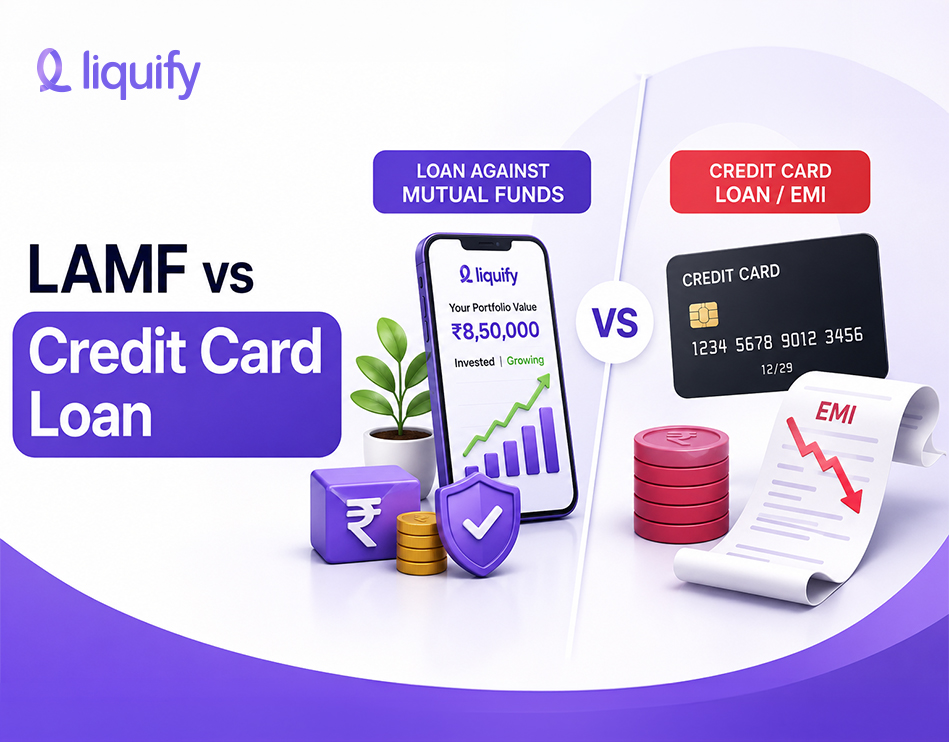
Loan Against Mutual Funds vs Credit Card Loan
When you need ₹1–5 lakh urgently, the credit card in your wallet feels like the fastest solution. Just swipe or convert your outstanding balance to EMI. But comparing mutual funds vs credit card loan options reveals a cost gap most people never calculate until the bill arrives.
Revolving credit card interest rates range from 36% to 42% p.a. in India. Even EMI conversion, which feels like the “cheaper” option, charges a 12–24% p.a. flat rate. A LAMF vs credit card loan comparison reveals a cost gap that’s hard to ignore.
If you hold mutual funds, there’s a secured borrowing option at 9–13% p.a.* that most credit card users never consider.
Key Takeaways
- Credit card revolving interest: 36–42% p.a. LAMF interest: 9–13% p.a.
- Credit card EMI conversion sounds cheaper at “12% flat,” but the effective annual rate is 21–23%
- Credit card EMI blocks your available credit limit, increasing your credit utilization ratio
- LAMF charges interest only on the withdrawn amount. Credit cards charge the full outstanding balance.
- Two missed credit card EMIs can drop your CIBIL score by 50–80 points
The Minimum Payment Trap: What Credit Card Debt Actually Costs
This is the scenario most people fall into. You spend ₹2 lakh on your credit card. Every month, you pay just the minimum due — 5% of the outstanding balance. It feels like you’re ‘managing’ the debt.
Here’s what happens at 36% p.a. revolving interest:
| Month | Outstanding | Minimum Payment (5%) | Interest Added | Remaining Balance |
| Month 1 | ₹2,00,000 | ₹10,000 | ₹6,000 | ₹1,96,000 |
| Month 3 | ₹1,88,000 | ₹9,400 | ₹5,640 | ₹1,84,240 |
| Month 6 | ₹1,71,000 | ₹8,550 | ₹5,130 | ₹1,67,580 |
| Month 12 | ₹1,39,000 | ₹6,950 | ₹4,170 | ₹1,36,220 |
After 12 months of “paying,” you’ve paid roughly ₹1,06,000. Your balance is still ₹1,36,000. Over ₹60,000 went purely to interest. The principal barely moved.
The same ₹2 lakh borrowed through LAMF at 9.3% p.a.* for 12 months costs a total of ₹18,600 in interest. That’s it. And you can repay at any time with no foreclosure charges.
How Do These Two Options Compare?
| Factor | Credit Card Loan/EMI | Loan Against Mutual Funds |
| Interest rate | 36–42% revolving, 12–24% flat EMI | 9–13% p.a.* |
| Effective annual rate | 21–42%, depending on type | 9–13% (reducing balance) |
| Processing fee | 1–2.5% of amount | ₹999 + GST at Liquify |
| Foreclosure charges | 2–3% | Zero at Liquify |
| Impact on credit limit | Blocks available limit | No impact on credit cards |
| Interest charged on | Full outstanding balance | Only withdrawn amount |
| Repayment flexibility | Fixed EMI or minimum due | Interest-only EMIs, principal anytime |
| CIBIL impact of high usage | Increases credit utilization ratio, hurts score | Secured loan, minimal impact |
A Real Cost Comparison: ₹2 Lakh for 6 Months
Credit card EMI at 15% flat rate (effective ~26% p.a.) :
- Total interest: ~₹15,000
- Processing fee: 1.5% = ₹3,000
- Foreclosure penalty if repaid in month 4: 2–3% = ₹2,500
- Credit limit blocked for 6 months
- Total cost: ~₹18,000–₹20,500
LAMF at 9.3% p.a.* on Liquify :
- Total interest: ~₹9,300
- Processing fee: ₹999 + GST
- Foreclosure if repaid in month 4: ₹0
- If repaid in month 4, interest drops to ~₹6,200
- The mutual fund portfolio keeps compounding during the loan
- Total cost: ₹7,199–₹10,299
The credit card route costs nearly double. And if you repay early, LAMF saves you even more because there’s no penalty. The credit card penalizes you for closing early.
When Does a Credit Card Loan Make Sense?
Very small amounts under ₹20,000
LAMF has a minimum portfolio requirement of ₹50,000 and a processing fee. For an expense of ₹10,000–₹15,000, paying with a credit card in full within the interest-free period (usually 20–50 days) costs nothing.
You can pay the full balance within the billing cycle
If you clear the entire outstanding balance before the due date, credit card interest is zero. This is genuinely free short-term credit. The problem starts when the balance rolls over.
You don’t hold any mutual funds
LAMF requires a portfolio. If you don’t have one, credit card EMI might be your only unsecured option for immediate access.
When Does LAMF Clearly Win?
Any amount above ₹50,000 that you can’t repay within 30 days
The moment credit card debt rolls past one billing cycle, interest starts compounding against you at 36–42% p.a. LAMF at 9.3% p.a.* is roughly one-fourth of that cost.
When you want repayment flexibility
Credit card EMI locks you into fixed monthly payments. LAMF lets you repay in chunks, anytime, with zero penalty. If cash flow is uneven, that flexibility saves real money.
When you want your credit score protected
A ₹2 lakh credit card EMI blocks that amount from your available limit. If your total limit is ₹3 lakh, your utilization ratio jumps to 67%. That hurts your CIBIL score. LAMF has no impact on your credit card utilization.
Which One Should You Choose?
The LAMF vs credit card loan answer is simple. If you hold mutual funds and need more than ₹50,000 for longer than 30 days, LAMF costs less, protects your credit score, and keeps your investments compounding. Credit cards work for small, short-duration expenses you can clear within the billing cycle.