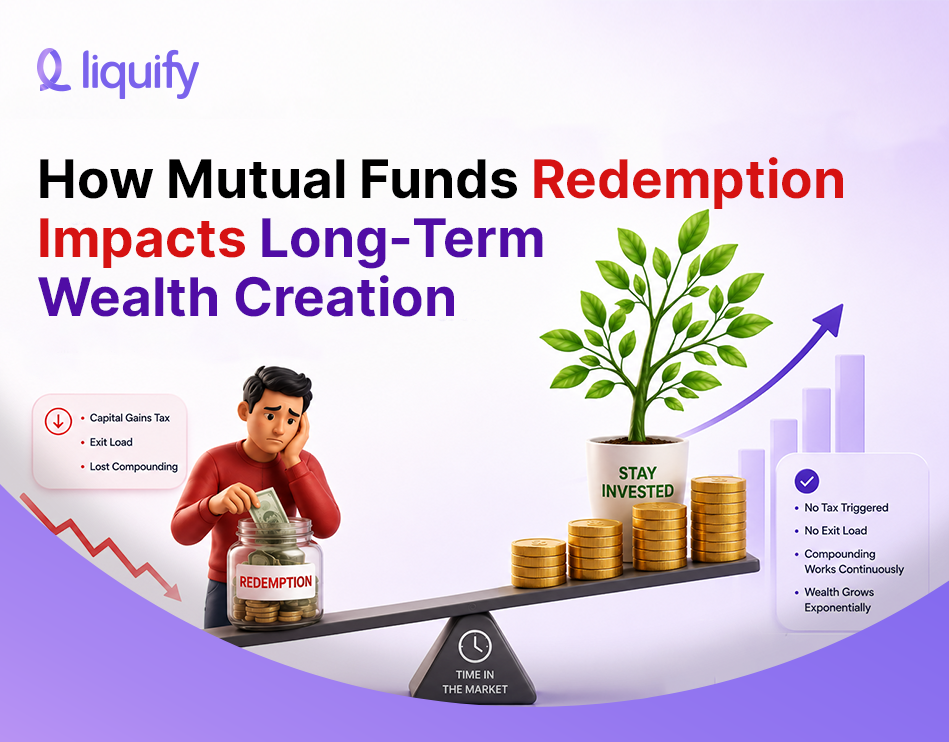
How Mutual Fund Redemption Impacts Long-Term Wealth Creation
Every month, a large number of Indian investors make a mutual fund redemption decision. Almost none of these decisions look reckless in isolation. A medical bill. A wedding expense. A tuition fee. A car down payment. Each one is a reasonable, considered choice.
The damage isn’t in any single decision — it’s in the pattern. Small, repeated mutual fund redemption over the years quietly dismantles the compounding engine that makes equity investing work in the first place, and most investors never see it happen because it doesn’t show up as a loss on any statement.
Key takeaways
- Every mutual fund redemption can trigger up to three costs: LTCG tax, exit load, and permanently lost compounding.
- ₹50,000 redeemed annually for 5 years destroys more long-term wealth than a single ₹2.5 lakh withdrawal of the same total amount.
- The same ₹2 lakh redeemed in year 5 of a SIP journey costs far more in lost future value than if redeemed in year 15.
- Most investors who redeem “to reinvest later” never actually put the same amount back.
- A loan against mutual funds exists specifically to meet short-term needs without triggering any of these three costs.
The Three Costs of Every Mutual Fund Redemption
1. Capital gains tax
If you’ve held your units for more than 12 months, gains above ₹1.25 lakh in a financial year attract 12.5% long-term capital gains (LTCG) tax under Section 112A of the Income Tax Act — a threshold and rate revised by the Finance Act, 2024 [regulatory citation: verify current Finance Act 2024 provisions]. Units held for less than 12 months fall under short-term capital gains (STCG) and are taxed at 20%. Either way, this is real cash leaving your pocket that would otherwise have stayed invested and compounding.
2. Exit load
Most equity funds charge a 1% exit load on units redeemed within 12 months of purchase, dropping to zero after that window. SIP investors rarely realize this load applies unit-by-unit, not to the SIP as a whole — your January installment and your June installment each carry their own 12-month clock, so a single redemption request can mix units that are load-free with units that aren’t.
3. Lost compounding
This is the cost that never appears on a statement, which is exactly why it’s the most dangerous of the three. The moment units are sold, compounding on that money stops permanently. The longer your original investment horizon was, the more expensive this silent cost becomes — and it’s almost always larger than the tax and exit load combined.
Why Small, Repeated Redemptions Do More Damage Than One Large One
In practice, few investors redeem ₹5 lakh in a single transaction. It’s usually ₹50,000 here, ₹80,000 there, ₹40,000 for something else — each one feels manageable in isolation, which is exactly why the cumulative damage goes unnoticed until much later.
Here’s what that looks like with real numbers. Starting portfolio: ₹10 lakh, growing at 12% p.a.
Investor A — redeems ₹2.5 lakh once, at the end of Year 1
| Year | Portfolio Value (after redemption) |
|---|---|
| Year 1 | ₹8.70 lakh (₹11.20L minus ₹2.5L) |
| Year 5 | ₹13.69 lakh |
| Year 10 | ₹24.12 lakh |
Investor B — redeems ₹50,000 every year for 5 years (same ₹2.5 lakh total)
| Year | Portfolio Value (after annual redemption) |
|---|---|
| Year 1 | ₹10.70 lakh |
| Year 5 | ₹11.89 lakh |
| Year 10 | ₹20.95 lakh |
Investor C — never redeems
| Year | Portfolio Value |
|---|---|
| Year 5 | ₹17.62 lakh |
| Year 10 | ₹31.06 lakh |
By Year 10, Investor B is sitting on ₹3.17 lakh less than Investor A — despite both having redeemed the exact same ₹2.5 lakh in total. The difference isn’t the amount; it’s the timing. Investor A’s withdrawal came out of the portfolio once and left the rest to compound uninterrupted. Investor B’s annual withdrawals each pulled out units that would otherwise have compounded for 9, 8, 7, 6, and 5 more years respectively. Every small redemption cut a different branch off the same compounding tree.
When You Redeem Matters as Much as How Much
Timing changes the cost of mutual fund redemption even when the amount stays identical. Consider ₹2 lakh redeemed at different points in a 20-year SIP journey, at an assumed 12% p.a.:
| Redemption Timing | Amount Redeemed | Value of Those Units at Year 20 |
|---|---|---|
| Year 3 | ₹2 lakh | ₹13.10 lakh |
| Year 7 | ₹2 lakh | ₹8.35 lakh |
| Year 12 | ₹2 lakh | ₹4.83 lakh |
| Year 17 | ₹2 lakh | ₹2.76 lakh |
Redeem ₹2 lakh in Year 3 and it costs you ₹13.10 lakh in future wealth. Redeem the same ₹2 lakh in Year 17, and it costs only ₹2.76 lakh. Early redemptions are disproportionately expensive precisely because those units had the longest compounding runway ahead of them — which is why mutual fund redemption in the early and middle years of an investment journey does the most lasting damage, even when the rupee amount looks identical on paper.
The “I’ll Reinvest Later” Problem
The most common justification investors give themselves before redeeming is some version of “I’ll put the money back once things settle down.” In practice, that rarely happens the way it’s planned. Investors who exit during a market downturn or a cash crunch typically don’t reinvest at the same level later — some wait for a “better entry point” that never quite arrives, some redirect the money elsewhere once it’s liquid, and some simply forget the original intention altogether.
What’s left behind is a permanent gap in the portfolio, one that widens every year it isn’t closed. Compounding doesn’t pause while you decide whether to reinvest. It simply continues without that money in it.
What Should You Do Instead of Redeeming?
If the need is short-term — say, 1 to 6 months — a loan against mutual funds lets you borrow against your existing portfolio at roughly 9–13% p.a.* without selling a single unit. Your investments stay invested, your SIPs continue uninterrupted, and once you repay, your portfolio is exactly where it would have been anyway. On platforms like Liquify, this process is fully digital, and funds are typically disbursed to your account within 24 hours.
For smaller, recurring expenses — anything under roughly ₹50,000 — a properly funded emergency fund is usually the simpler answer, since it meets the need without touching the portfolio or involving any borrowing at all.
The underlying principle is simple: the longer your units stay invested, the longer they keep compounding, and the larger your eventual wealth. Every mutual funds redemption interrupts that process — sometimes for a good reason, but always at a real cost.