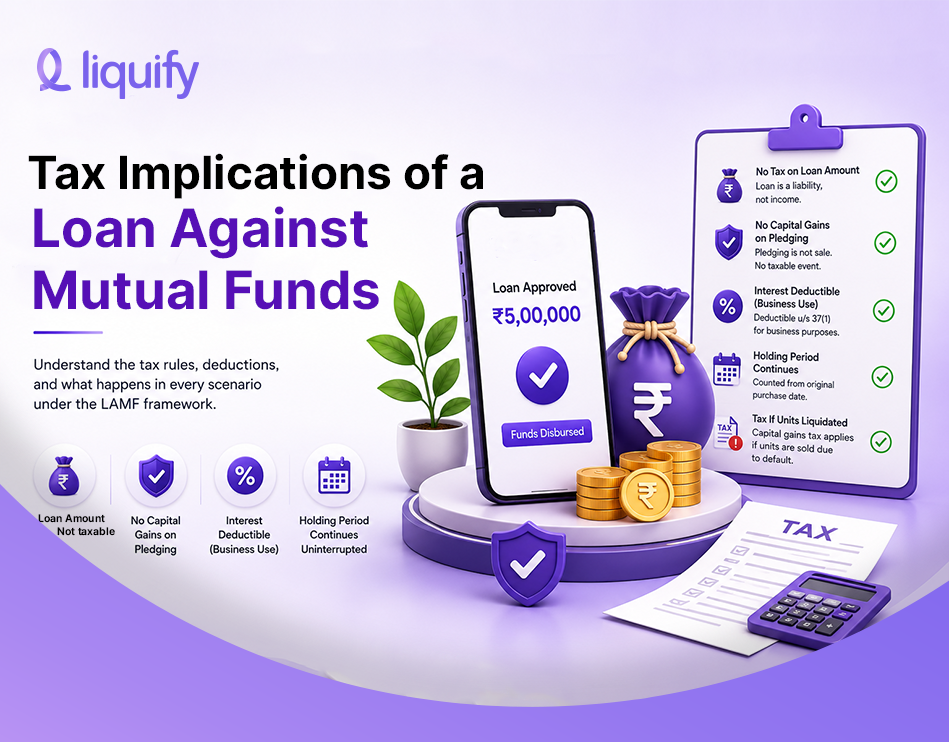
Tax Implications of a Loan Against Mutual Funds
The biggest tax advantage of a loan against mutual funds tax 2026 framework is simple: it doesn’t trigger a taxable event. You don’t sell any units. Capital gains stay unrealised. And the loan amount itself carries zero tax liability. Your holding period continues uninterrupted from the original purchase date.
That said, there are specific tax rules around interest deductions, forced liquidation, and GST on fees that every borrower should understand. This guide covers each one with accurate, current details under the loan against mutual funds tax framework applicable in FY 2026–27.
Loan Against Mutual Funds Tax 2026 – Key Takeaways
- The loan amount received is not taxable. A loan is a liability, not income.
- Pledging mutual fund units does not trigger capital gains tax. No sale or transfer takes place.
- Interest paid on LAMF is tax-deductible only if the loan is used for business purposes [Section 37(1), Income Tax Act]
- Budget 2026 removed the deduction for interest on loans taken to invest in shares or mutual funds, effective April 1, 2026
- If the lender liquidates your pledged units due to default, capital gains tax applies on the liquidated units
Is the Loan Amount Taxable?
No. A loan is a financial liability. The money credited to your bank account when the lender disburses the loan is not treated as income under any provision of the Income Tax Act. No TDS is deducted from the disbursed amount. This applies regardless of the loan size or how you use the funds.
Does Pledging Mutual Funds Trigger Capital Gains Tax?
No. Pledging is not a sale, transfer, or redemption. When you pledge your mutual fund units as collateral, the lender places a digital lien on them through CAMS or KFintech. The units remain in your folio under your name. You remain the legal owner.
Since no transfer of ownership occurs, no capital gains event is triggered. Your holding period also continues uninterrupted from the original purchase date. If you bought units in January 2024 and pledged them in June 2026, the holding period is still counted from January 2024 for tax purposes when you eventually redeem.
Is the Interest Paid on LAMF Tax-Deductible?
This depends entirely on how you use the loan proceeds. Here’s a clear breakdown:
| End Use of Loan | Interest Deductible? |
| Business expenses | Yes |
| House purchase or construction | May qualify |
| Personal expenses (medical, wedding, travel) | No |
| Investing in shares or mutual funds | No (from April 2026) |
For most retail investors using LAMF for personal emergencies, wedding expenses, or education fees, the interest is not tax-deductible. For business owners and self-employed professionals using LAMF for working capital, the interest qualifies as a business expense.
What Changed in Budget 2026?
Before April 2026, investors could claim a deduction for interest paid on loans taken to invest in listed equity shares or mutual funds. Investors could set off this interest against dividend income or capital gains.
Budget 2026 removed this deduction entirely. Effective April 1, 2026, the law no longer allows any deduction for interest expenditure incurred to earn dividend income or income from mutual fund units. This means that dividend and mutual fund income is now fully taxable, with no interest offset.
This change is relevant to investors who were using LAMF to fund further market investments. The tax benefit of that strategy no longer exists.
What Happens If the Lender Liquidates Your Units?
If you default on the loan and the lender redeems your pledged units to recover the outstanding amount, that redemption is a taxable event. Capital gains tax applies according to the type of fund and your holding period:
Equity mutual funds:
- Held over 12 months: 12.5% LTCG on gains above ₹1.25 lakh per financial year [Section 112A]
- Held under 12 months: 20% STCG [Section 111A]
Debt mutual funds (purchased after April 1, 2023):
- Your income tax slab rate taxes all gains, irrespective of holding period
The forced liquidation typically happens at a depressed NAV during a market downturn, which means you could be paying tax on gains while your actual portfolio has lost value. This is the worst-case tax outcome, and it’s avoidable by maintaining a conservative LTV and keeping buffer units unpledged.
LAMF vs Redemption: A Tax Comparison
| Tax Factor | LAMF (Pledging) | Redemption (Selling) |
| Capital gains tax | Not triggered | 12.5% LTCG / 20% STCG |
| Holding period | Continues from original date | Ends on redemption date |
| Exit load | Not applicable | 1% if under 12 months |
| Tax on loan amount | Not taxable | Not applicable |
| Interest deduction | Only for business use | Not applicable |
The loan against mutual funds tax advantage is clear for investors with significant unrealised gains. A portfolio sitting on ₹3 lakh in gains would owe roughly ₹21,875 in LTCG tax on redemption [(₹3L minus ₹1.25L) × 12.5%]. With LAMF, that tax bill is zero because no sale happens.
Does GST Apply on LAMF Fees?
Yes. The processing fee charged by the lender is subject to 18% GST. On Liquify’s processing fee of ₹999, the GST adds approximately ₹180, bringing the total to ₹1,179. Interest payments on the loan itself are exempt from GST as financial services.
Consult a Tax Professional
Tax rules change with every budget cycle. However, your specific tax situation depends on:
- Your income slab
- The type of mutual funds you hold
- How you use the loan proceeds
So, always consult a SEBI-registered financial advisor or a chartered accountant before making tax-related decisions.