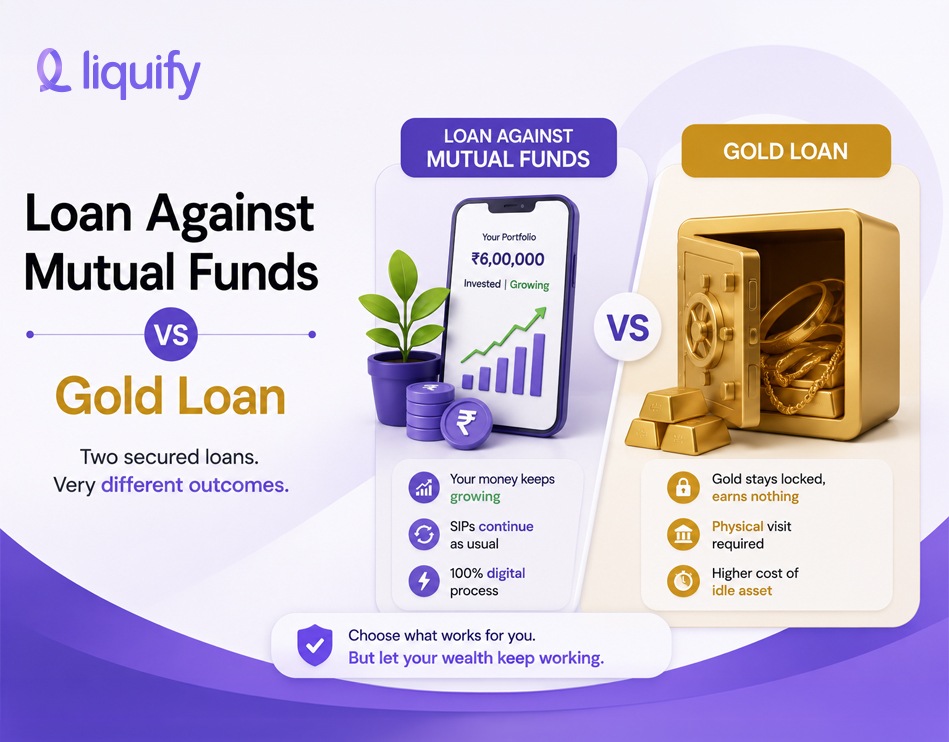
Loan Against Mutual Funds vs Gold Loan
When it comes to mutual funds vs gold loan, both let you borrow against an asset you already own without selling it. And both charge lower interest than a personal loan because the lender holds collateral. That’s where the similarities end.
The real difference between LAMF vs gold loan is what happens to your asset while it serves as collateral. Gold goes into a vault.It doesn’t grow. Returns stay at zero. It just waits. Your mutual fund units stay in your folio, continue compounding, keep earning market returns, and your SIPs run as usual. That distinction changes the math entirely.
Key Takeaways
- Gold loan interest rates start at around 8.05% p.a. (banks), LAMF starts at 9% p.a.
- Gold loan LTV is tiered: 85% for loans under ₹2.5 lakh, 80% for ₹2.5–5 lakh, 75% above ₹5 lakh (effective April 2026)
- LAMF LTV: up to 75% for equity MF, up to 85% for AAA-rated debt
- Gold sits idle during the loan. Mutual fund units keep compounding.
- Gold loans require a branch visit and physical handover. LAMF is fully digital.
How Do These Two Loans Actually Compare?
| Factor | Gold Loan | Loan Against Mutual Funds |
| Collateral | Physical gold jewellery or coins | Mutual fund units (digital lien) |
| Interest rate | Starts from 8.05% p.a.* (banks), up to 26% (NBFCs) | 9%–13% p.a.* |
| LTV | 75–85% (tiered by loan amount) | 50–85% (by fund type) |
| Disbursal | 30 minutes to 24 hours (branch) | Within 24 hours (fully digital) |
| Asset during loan | Locked in lender’s vault | Stays in your folio, keeps earning returns |
| Physical visit | Required for gold valuation and handover | Not required. The entire process is digital. |
| Default risk | Gold auctioned by lender | Pledged MF units liquidated by lender |
| SIP continuity | Not applicable | SIPs continue unaffected |
| Repayment | EMI or bullet repayment | Interest-only EMIs, principal anytime |
What Happens to Your Asset During the Loan?
This is where the LAMF vs gold loan comparison gets interesting.
When you take a gold loan, your jewellery is placed in the lender’s vault and remains there until repayment. It might appreciate, but you earn nothing from it. The gold is completely idle.
With LAMF, your units stay in your folio behind a digital lien. They remain invested, participate in market growth, and your SIPs keep running. The compounding doesn’t stop.
A Real Cost Comparison: ₹3 Lakh for 4 Months
Gold loan at 10% p.a. :
- Interest: ₹3,00,000 × 10% × (4/12) = ₹10,000
- Processing fee: ₹1,500–₹3,000
- Your gold earns nothing while in the vault
- Total effective cost: ~₹11,500–₹13,000
LAMF at 9.3% p.a.* on Liquify :
- Interest: ₹3,00,000 × 9.3% × (4/12) = ₹9,300
- Processing fee: ₹999 + GST
- Meanwhile, your ₹6 lakh pledged portfolio (assuming you borrowed against ₹6 lakh at 50% LTV) earns ~₹24,000 at 12% annual returns
- Total effective cost: ~₹10,299, offset by ~₹24,000 in portfolio growth
The gold loan has a slightly lower headline rate. But when you factor in what your mutual fund portfolio earns during the same period, LAMF costs less in real terms. The asset that keeps working for you changes the equation.
When Does a Gold Loan Make More Sense?
You don’t hold mutual funds
If your only pledgeable asset is gold, a gold loan is your secured borrowing option.
You need a very small amount
For loans under ₹2.5 lakh, gold loans now offer 85% LTV. That’s significantly higher than the 50% LTV on equity mutual funds. If you hold ₹2 lakh in gold versus ₹2 lakh in equity MF, the gold gives you ₹1.7 lakh while the MF gives you ₹1 lakh.
You prefer bullet repayment
Gold loans allow you to pay the entire principal at the end of the tenure. LAMF operates as an overdraft with interest-only EMIs.
When Does LAMF Make More Sense?
You want your asset to keep growing
Gold in a vault earns nothing. Mutual fund units keep compounding. For any loan tenure beyond 2–3 months, this difference adds up meaningfully.
You want a fully digital process
No branch visit. Skip the gold valuation. Zero physical handover. LAMF runs entirely through apps like Liquify using PAN, Aadhaar, and digital lien marking through CAMS and KFintech.
You don’t want physical asset risk
Gold in a lender’s vault carries storage risk. Lender vaults are insured, but the process of getting your gold back after repayment can take up to 7 days under the new RBI framework. With LAMF, lien removal is digital and immediate after repayment.
You want flexible repayment
LAMF lets you repay in chunks anytime. Liquify charges zero foreclosure fees. Many gold loan lenders charge 1–2% for early closure.
The Bottom Line
The mutual funds vs gold loan decision comes down to one question: Do you want your collateral to work for you during the loan, or do you accept it sitting idle? If you hold both gold and mutual funds, LAMF preserves compounding and maintains your investment strategy. Gold loans offer higher LTV on small amounts and are accessible to anyone with physical gold.
For mutual fund investors, the math consistently favours LAMF.