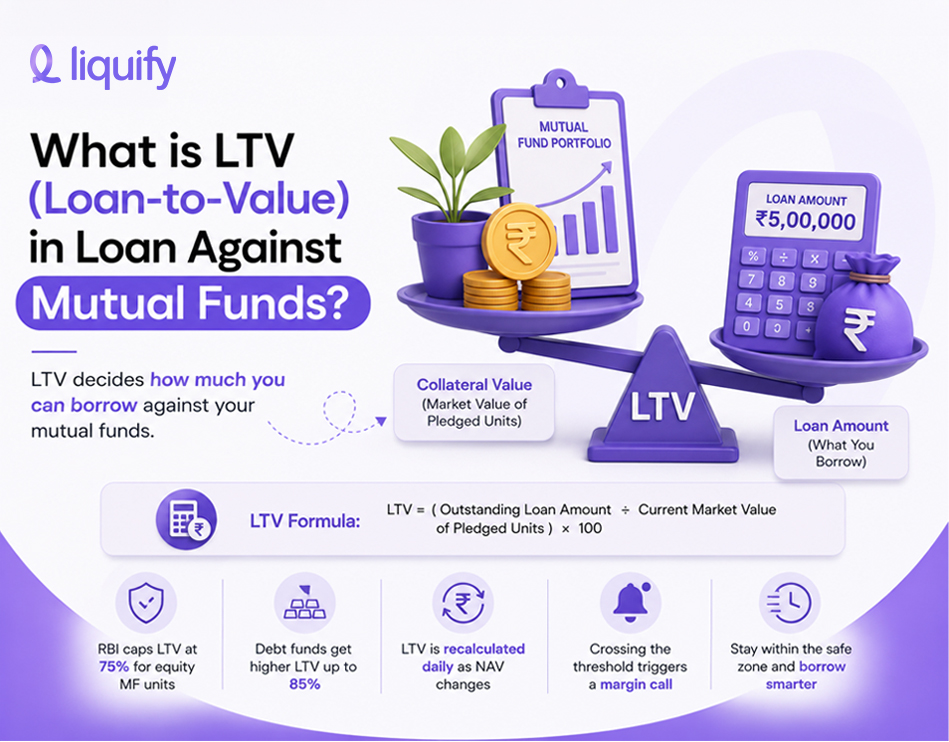
What is LTV (Loan-to-Value) in Loan Against Mutual Funds?
If you’ve ever looked at a loan against mutual funds and seen terms like “50% LTV” or “80% LTV,” this is the number that decides everything. LTV in loan against mutual funds determines how much you can borrow, how much risk the lender carries, and what happens to your loan when markets move up or down. It’s one number, but it controls the entire facility.
In simple terms, LTV is the ratio between what you borrow and what your pledged mutual funds are worth.
Key Takeaways
- LTV = (loan amount ÷ collateral value) × 100
- RBI caps LTV at 75% for equity MF units, though most lenders apply 45–50% internally
- Debt mutual funds get a higher LTV at up to 85% for AAA-rated debt because of lower NAV volatility
- LTV is recalculated daily as NAV changes.
- Crossing the lender’s LTV threshold triggers a margin call
How Is LTV Calculated in Loan Against Mutual Funds?
The formula is straightforward:
LTV = (Outstanding Loan Amount ÷ Current Market Value of Pledged Units) × 100
But here’s what most borrowers miss. This calculation runs twice in very different ways.
At the time of borrowing:
Your portfolio NAV is ₹10 lakh. The lender applies a 50% LTV ratio and offers you ₹5 lakh. Your LTV is 50% at this point.
Three months later, after a market correction:
Your portfolio NAV drops to ₹8 lakh. You still owe ₹5 lakh. Your LTV is now 5,00,000 ÷ 8,00,000 × 100 = 62.5%.
You didn’t borrow more money. The market moved, and your LTV shifted on its own. This is the single most important thing to understand about LTV in loan against mutual funds.
What LTV Ratios Do Lenders Offer in 2026?
Different fund types have different LTV ratios, and this is due to volatility. Here’s how it breaks down:
| Fund Type | RBI Ceiling | Typical Lender LTV | Why This LTV? |
| Equity MF | 75% | 45–50% | Higher NAV swings need a bigger safety cushion |
| Debt MF | 85% (AAA debt) | 75–85% | Stable NAV means lower risk for the lender |
| Hybrid MF | ~65% | 55–60% | Mixed volatility based on equity-debt split |
The gap between the RBI ceiling and the lender’s actual LTV is important. The RBI sets the maximum. Lenders apply stricter limits based on their own risk assessment, the specific fund’s AUM, and its historical volatility. That’s why the same portfolio might get you different credit limits at different lenders.
Liquify offers competitive LTV ratios starting at 9.3% p.a.* interest. You can check your specific credit limit in just a few seconds.
Why Does LTV Change During Your Loan?
Three things can shift your LTV after you’ve borrowed:
1. Markets rise
Your portfolio NAV goes up, your collateral value increases, and LTV drops. You actually gain more borrowing headroom without doing anything.
| Before | After 15% Rally | |
| Portfolio value | ₹10 lakh | ₹11.5 lakh |
| Loan outstanding | ₹5 lakh | ₹5 lakh |
| LTV | 50% | 43.5% |
2. Markets drop
Your NAV falls, collateral shrinks, and LTV spikes. You’re closer to a margin call.
| Before | After 20% Drop | |
| Portfolio value | ₹10 lakh | ₹8 lakh |
| Loan outstanding | ₹5 lakh | ₹5 lakh |
| LTV | 50% | 62.5% |
3. You repay part of the principal
Loan amount decreases. LTV drops even if markets stay flat. This is the one lever you have complete control over.
What Happens When LTV Crosses the Lender’s Threshold?
Stage 1: Warning zone
LTV reaches 55–60% for equity funds. Most lenders send an alert. No action required yet, but it’s a signal to watch the market closely.
Stage 2: Margin call
LTV crosses the lender’s threshold, typically around 60–65% for equity. The lender asks you to pledge additional units or make a partial repayment. RBI guidelines give you up to 7 working days to address the shortfall.
Stage 3: Forced liquidation
If the margin call goes unmet, the lender has the right to redeem your pledged units to bring the LTV back within limits. This is the worst-case scenario, and it’s entirely avoidable with proper planning.
How Does LTV in LAMF Compare to Other Secured Loans?
| Loan Type | Typical LTV | Collateral |
| Home loan | 75–90% | Property |
| Gold loan | 75% (tiered) | Gold jewellery |
| Loan against FD | 90–95% | Fixed deposit |
| LAMF (equity) | 45–50% | Mutual fund units |
| LAMF (debt) | Up to 85% | Mutual fund units |
LAMF has the lowest LTV among secured loans for equity funds because mutual fund NAV is the most volatile collateral on this list.
How to Keep Your LTV in a Safe Zone
1.Borrow below your limit
If your sanctioned credit is ₹5 lakh, draw only ₹3–3.5 lakh. A 35–40% utilisation gives you room to absorb a market dip without triggering a margin call.
2.Repay in chunks
Every partial repayment reduces your outstanding loan balance and lowers your LTV. Even small repayments help.
3.Keep buffer units unpledged
If you pledge only 60–70% of your total portfolio, the remaining 30–40% is available to pledge additionally if a margin call arrives.
4.Monitor during volatile markets
A 10–15% market correction can push your LTV from a comfortable 45% to a risky 55% in days. Weekly checks during volatile periods keep you ahead of surprises.
Check Your LTV Before You Borrow
Your loan eligibility and credit limit depend entirely on your portfolio’s current NAV and the lender’s LTV ratio. The Liquify app shows your exact LTV and credit limit in seconds. Knowing that number today means you can act within 24 hours when you actually need the funds.
Interest rates are subject to change based on lender policies, portfolio composition, and market conditions. Visit liquify.in for the latest rates.