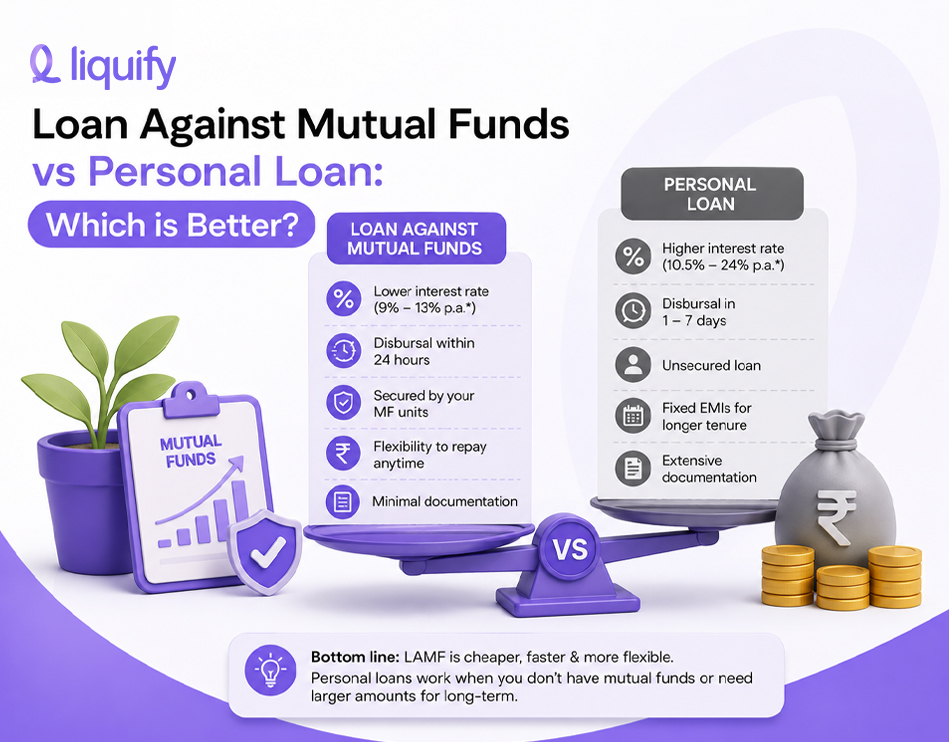
Loan Against Mutual Funds vs Personal Loan: Which is Better?
You need ₹3–5 lakh. Maybe it’s a medical bill, a wedding advance, or a business payment that can’t wait. When comparing a loan against mutual funds vs personal loan, the two most common options, the difference lies in what they cost you, how quickly they arrive, and what they ask of you in return.
If you hold mutual funds, this LAMF vs personal loan comparison is worth understanding before you apply for anything. The right choice could save you tens of thousands in interest and fees.
Key Takeaways
- A loan against mutual funds vs personal loan comparison comes down to one core difference: secured (LAMF) vs unsecured (Personal Loan)
- LAMF rates start at 9–13% p.a.*, personal loans range from 10.5–24% p.a.*
- Personal loans depend heavily on CIBIL score, salary, and employer profile. LAMF depends on your portfolio.
- LAMF disburses within 24 hours on digital platforms. Personal loans take 1–7 days.
- Most personal loans in India are fixed-rate, which means prepayment penalties of 2–4% still apply despite the RBI’s 2026 floating-rate exemption
- LAMF works best for short-term needs under 6 months. Personal loans suit borrowers who don’t hold mutual funds.
Loan Against Mutual Funds vs Personal Loan: Key Differences
Here’s a detailed side-by-side comparison of LAMF vs personal loan across the factors that matter most:
| Factor | Personal Loan | Loan Against Mutual Funds |
| Type | Unsecured | Secured (MF units as collateral) |
| Interest rate | 10.5–24% p.a.* | 9–13% p.a.* |
| Disbursal time | 1–7 working days | Within 24 hours |
| Approval based on | CIBIL score, salary, employer profile | Mutual fund portfolio value |
| CIBIL score needed | 750+ preferred | Minimal role |
| Repayment structure | Fixed monthly EMIs | Interest-only EMIs, principal anytime |
| Foreclosure charges | 2–4% on fixed-rate loans | Zero on Liquify |
| Documentation | Salary slips, bank statements, employer ID, address proof | PAN, Aadhaar, MF folio |
| End-use restrictions | Varies by lender | None |
| Maximum amount | Based on income (typically 10–15x monthly salary) | Based on portfolio NAV and LTV ratio |
When Does a Loan Against Mutual Funds Make More Sense?
Your CIBIL score is below 750
Personal loan rates jump sharply for scores below 750. LAMF doesn’t depend on your credit score because the mutual fund portfolio secures the loan. The rate stays the same.
You need money within 24 hours
Personal loan applications go through income verification, employer checks, and credit bureau pulls. That takes days. On platforms like Liquify, the entire LAMF process is digital. PAN-based eligibility check, digital pledge through CAMS and KFintech, Aadhaar e-KYC, and funds in your account within 24 hours.
Your need is short-term and you want flexibility
Personal loans lock you into fixed EMIs for 12–60 months. LAMF works as an overdraft. You pay interest only on what you withdraw, repay whenever cash flow allows, and Liquify charges zero foreclosure fees. If you need ₹3 lakh for 4 months, you pay 4 months of interest and close. No penalty.
Your portfolio has large unrealised gains
If you were considering redeeming mutual funds instead of taking a personal loan, LAMF removes that temptation entirely. Your units stay pledged, compounding continues, and you avoid LTCG tax at 12.5% [Section 112A, Income Tax Act].
When Does a Personal Loan Make More Sense?
You don’t hold any mutual funds
LAMF requires a minimum portfolio of ₹50,000. If you don’t have mutual fund investments, a personal loan is your available option.
Your loan tenure is 12+ months with predictable income
If you earn a stable salary and want a structured repayment plan over 2–3 years, fixed EMIs from a personal loan can make budgeting simpler.
You need more than your portfolio can support
LAMF is limited by the LTV ratio. Equity funds give you up to 50% of NAV. If you hold ₹5 lakh in equity funds, your maximum credit limit is ₹2.5 lakh. A personal loan has no such ceiling and is based on your income profile.
A Real Cost Comparison: ₹3 Lakh for 6 Months
Let’s run the numbers on a ₹3 lakh loan for 6 months:
Personal loan at 16% p.a. (fixed EMI):
- Total interest: ~₹15,400
- Processing fee: ₹3,000–₹5,000
- Foreclosure penalty if repaid in month 4: 2–3% of outstanding, roughly ₹2,000–₹4,500
- Total cost: ₹20,400–₹24,900
LAMF at 9.3% p.a.* on Liquify:
- Total interest: ~₹13,950
- Processing fee: ₹999 + GST
- Foreclosure penalty if repaid in month 4: ₹0
- If repaid in month 4 instead of 6, interest drops to ~₹9,300
- Total cost: ₹10,299–₹14,949
The gap widens further if you repay early. With LAMF, early repayment saves you money. With a fixed-rate personal loan, early repayment can cost you a penalty.
Loan Against Mutual Funds vs Personal Loan: Credit Score Impact
Personal loan:
Shows as unsecured debt on your CIBIL report. Every application leads to a hard inquiry, which may temporarily decrease your score by 5–10 points. Multiple applications in a short period flag you as credit-hungry.
LAMF:
Shows as secured debt. Most digital platforms run soft pulls, which don’t affect your score. The secured nature means it carries a lower risk weight on your credit profile.
Both:
Timely repayment builds your score. Defaults hurt it. The difference is that LAMF starts with a lighter footprint on your credit file.
How to Decide in 60 Seconds
Three questions can settle this LAMF vs personal loan decision:
- Do you hold mutual funds worth at least ₹1 lakh? If not, a personal loan is your route.
- Is your borrowing need under 6 months? If yes, LAMF wins on cost and flexibility.
- Is your CIBIL score below 750? If yes, LAMF gives you a better rate because it doesn’t depend on your credit score.
Check your LAMF eligibility on Liquify.
*Interest rates are subject to change based on lender policies, portfolio composition, and market conditions. Visit liquify.in for the latest rates.